

NILGIRI LANGUR ALSO CALLED JOHN'S LEAF MONKEY
Langurs are colobane (stub thumbed) monkey tribe belonged to old world Monkey family. They are medium sized primates with long tail, complex foregut and stub thumb. They are arboreal and folivorous. They have no cheek pouch but long digestive tracts. Nilgiri langur , also called John’s leaf monkey, is a member of Langur endemic to Western Ghats of South India. They are placed in the family’ Trachypithecus’. Its scientific name is Trachypithecus johnii. The population status of this primate is ‘endangered’. Its distribution is restricted to Evergreen (and degraded evergreen) forests of South Western Ghats, Nilgiri and up to Kodagu region in Western Ghats. Recent studies revealed that the money is closely related to Common Langur than to leaf monkeys.
Nilgiri Langur (Trachypithecus johnii)
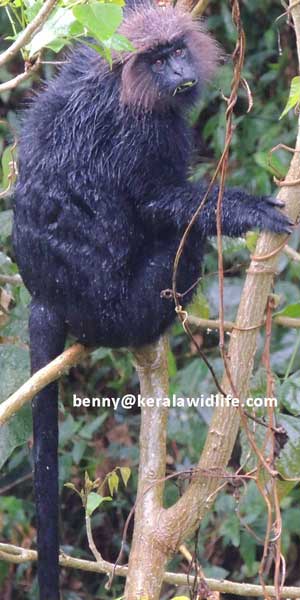
The colour of the monkey is glossy black. Its crown is yellowish brown. Female has a distinctive greyish white patch in its thighs. Young are brownish black. Those who survive in degraded evergreen forests (deciduous by anthropogenic factors) shows more greyish colour than those found in evergreen forests
Size of male monkey including tail is 160cm male and female 140cm approximately. The body weight of male is between 10 kg to 15kg, where as female has 9kg to 12kg approximately. Their social system is male dominating ‘unimale’ community. The number in troops is depends on richness of habitat.
Major diet of Nilgiri Langur consists of leafs and buds, but sometimes feed on nuts and fruits, insects etc. Soil licking is also found among them.
Vocalisation and silence is its distinctive feature for survival. They produce 16 types of sounds of which 5 are produced only by male (National Studbook of Nilgiri Langur).
Nilgiri langur is a threatened species and placed among 25 most endangered primates. Major threats faced by Nilgiri langur in its only habitat on earth is habitat destruction through felling, encroachment for plantations, eucalyptus and other commercial tree cultivation initiated by the department of forests etc. The so called medicinal and aphrodisiacs effects of its flush, blood, limbs and internal organs this monkey was hunted from time immemorial. The Mudva tribes of Anamalais hunted Nilgir Langur for ancestral worship (L.A Krishna Iyar)
BEST PLACE TO SEE AND PHOTOGRAPH


